|
FGE is proud to offer a new line of rapid load testing, simply
called the RLT, capable of up to 450 tons. The innovative RLT
system makes use of a load pack that converts drop energy into a
long-duration load pulse and thereby availing simplified kinematic
data reduction methods.
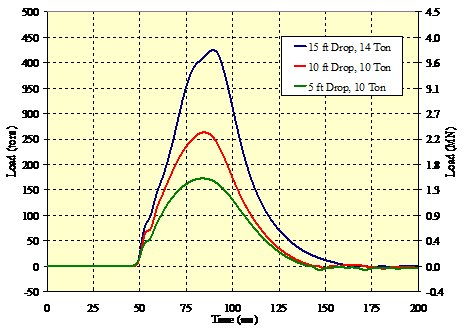
Three consecutive load cycles on a 48 inch diameter drilled shaft.
Note load duration is approximately 100 msec making it ideal for present data analysis methods.
The development of this device has been funded solely by FGE who
contracted the University of South Florida to aid in development of
key components and conduct independent verification testing.
Components
The RLT system has three main components which include: the load
pack, a drop weight (mass) and a suspension/guide tower.
Load Pack. The loading assembly, which is mounted directly to the
top of the foundation, is comprised of a specially designed
attenuator assembly and a series of load cells for redundant
measurements. The pack design is modular allowing for future larger
load ranges. The present system is suitable for 100 to 400 ton
loads, with future systems approaching 2000 tons.
Drop Mass. The mass assembly is modular providing for optimal
shipping and cost effectiveness and in its current configuration can
weigh as much as 14 tons. Specialized RLT software is used to
determine the most appropriate mass configurations prior to
shipping.
Guide Tower. The tower is used to support the mass at a desired
height, as well as guide the mass during the test. It is equipped
with a hydraulically actuated quick-release that safely drops the
mass at the desired time.
Operation
Essentially, the test is conducted by suspending the mass from the
tower above the loading assembly at a desired height, then releasing
the mass by the use of a quick release and allowing it to impact the
loading assembly. Upon impact the attenuator assembly is engaged
and it transmits the force to the foundation through calibrated load
cells in a controlled and relatively prolonged manner producing a
load pulse, rather than an impact. The rebound hysteretic response
of the attenuator assembly is very efficient at absorbing the energy
resulting in drastically reduced subsequent drop heights.
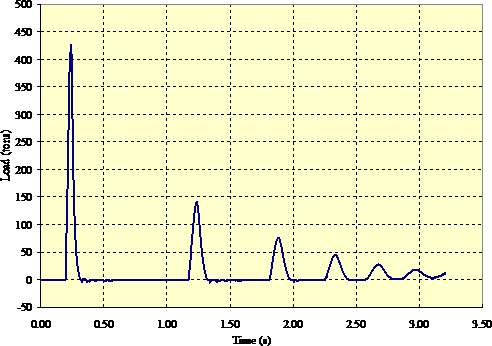
Load attenuation via specially designed load pack.
Regression
Well-known data analysis methods directly apply to RLT data thereby
producing equivalent static test results.
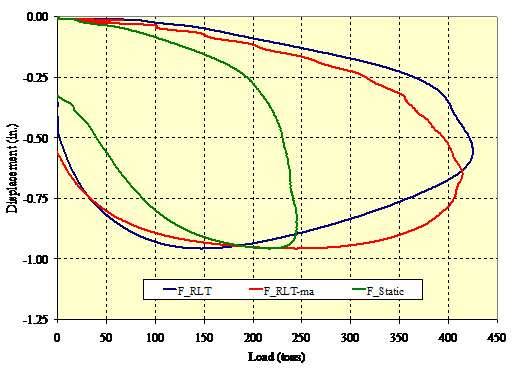
Results of Unloading Point Analysis performed on Rapid Load Test of
48” Diameter Drilled shaft.
|